Cottonmouth
A bite is a medical emergency. Most snakes people call water moccasins outside its range are harmless water snakes.
- Lives in
- 15 states
- Size
- 30–48 in
- Open US records
- 8,367
- Group
- Snake
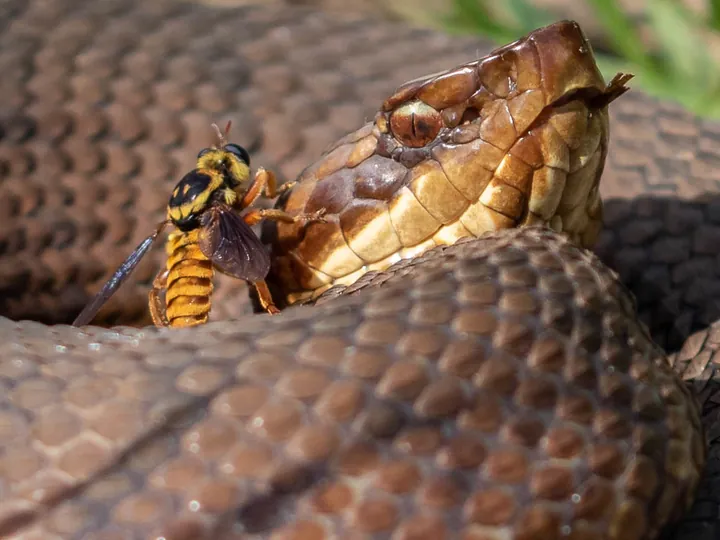
How to identify it
- Heavy, dark olive to black body; bands fade with age
- Broad flat head with a dark stripe through the eye
- Swims with the whole body high on the water
- Opens its mouth wide to show the white lining when threatened
Size: 30–48 in (total length). Habitat: Swamps, slow rivers, marshes and ditches of the Southeast.
Also called water moccasin, northern cottonmouth, Florida cottonmouth.
Includes the Florida cottonmouth (A. conanti), split as a separate species in 2015.
Where it lives
- Lives here
- Rare records
- Gone
- Not here
When it is out
Look-alikes
- Copperhead vs Cottonmouth Copperhead: medically significant
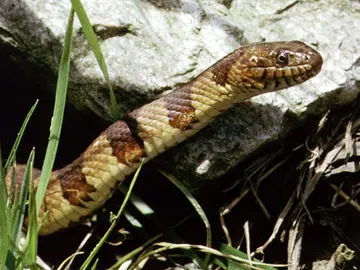
- Cottonmouth vs Water Snake Water snake: harmless
- Cottonmouth vs Banded Water Snake Banded water snake: harmless
- Cottonmouth vs Diamondback Water Snake Diamondback water snake: harmless
- Cottonmouth vs Brown Water Snake Brown water snake: harmless
State by state
| State | Status | Open records | Counties |
|---|---|---|---|
| Texas | Lives here | 1,790 | 116 |
| Louisiana | Lives here | 1,469 | 53 |
| Florida | Lives here | 1,109 | 59 |
| North Carolina | Lives here | 567 | 43 |
| Illinois | Lives here | 482 | 8 |
| Virginia | Lives here | 476 | 12 |
| Oklahoma | Lives here | 461 | 32 |
| Arkansas | Lives here | 421 | 38 |
| Mississippi | Lives here | 309 | 36 |
| Georgia | Lives here | 300 | 33 |
| Alabama | Lives here | 259 | 40 |
| South Carolina | Lives here | 253 | 24 |
| Missouri | Lives here | 201 | 14 |
| Tennessee | Lives here | 186 | 17 |
| Kentucky | Lives here | 66 | 6 |
| Kansas | Rare records | 8 | 5 |
| Colorado | Rare records | 1 | 0 |
| Indiana | Rare records | 1 | 0 |
| Maryland | Rare records | 1 | 1 |
| Massachusetts | Not here | 2 | 1 |
| Minnesota | Not here | 2 | 0 |
| Arizona | Not here | 1 | 1 |
| New York | Not here | 1 | 1 |
| Pennsylvania | Not here | 1 | 0 |
States not listed have no open records and are outside the range.
Questions
Where does the cottonmouth live?
In 15 states: Alabama, Arkansas, Florida, Georgia, Illinois, Kentucky, Louisiana, Mississippi, Missouri, North Carolina, Oklahoma, South Carolina, Tennessee, Texas and Virginia. Rare records also come from Colorado, Indiana, Kansas and Maryland.
Is the cottonmouth dangerous?
Dangerous. A bite is a medical emergency. Most snakes people call water moccasins outside its range are harmless water snakes.
How do you identify a cottonmouth?
Heavy, dark olive to black body; bands fade with age. Broad flat head with a dark stripe through the eye. Swims with the whole body high on the water.
When is the cottonmouth most active?
Most open US records fall in April to July, September.