Copperhead vs Northern Water Snake

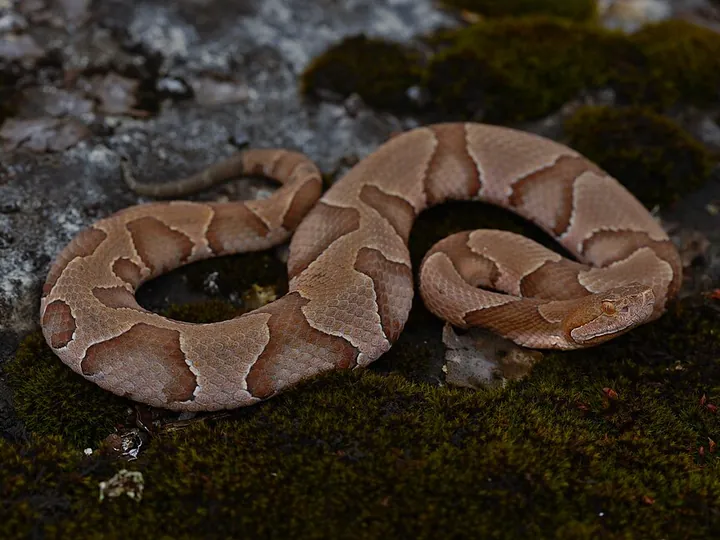
The quick tellOn a copperhead the bands are wide on the sides and narrow on the back, like an hourglass. On a northern water snake they are wide on the back and narrow on the sides.
Copperhead (Agkistrodon contortrix)

Photo: Peter Paplanus, CC BY 2.0, via Wikimedia Commons

Copperhead

Medically significant · Agkistrodon contortrix

  • Copper to tan body with dark hourglass bands: wide on the sides, narrow on the spine
  • Plain coppery head with no pattern
  • Young snakes have a bright yellow-green tail tip
  • Cat-like vertical pupils and a pit between eye and nostril

Size: 24–36 in. Habitat: Wooded hillsides, rocky ridges, wood piles and suburban yards in the East and South.

The venomous snake behind most bites in the eastern US. Bites are painful and need medical care, but deaths are extremely rare.
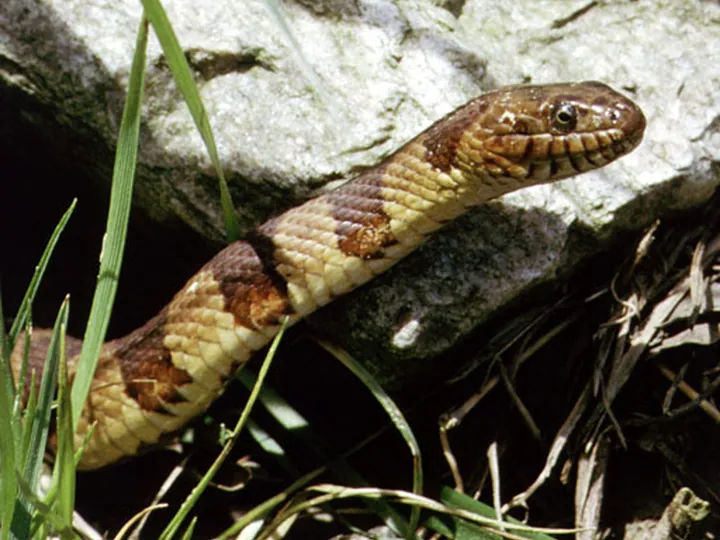
Northern water snake (Nerodia sipedon)

Photo: Patrick Coin, CC BY-SA 2.5, via Wikimedia Commons

Northern water snake

Harmless · Nerodia sipedon

  • Dark crossbands near the head that break into blotches toward the tail
  • Bands are widest on the back, narrow on the sides (the opposite of a copperhead)
  • Round pupils, no heat pit
  • Belly with reddish half-moons

Size: 24–42 in. Habitat: Lakes, rivers, ponds and marshes from the Great Lakes to the Gulf states.

Not venomous. It bites if grabbed and musk smells bad, but it is harmless.

Where each one lives

Alabama: both live hereAlaska: neitherArizona: neitherArkansas: both live hereCalifornia: neitherColorado: Northern water snake onlyConnecticut: both live hereDelaware: both live hereFlorida: both live hereGeorgia: both live hereHawaii: neitherIdaho: neitherIllinois: both live hereIndiana: both live hereIowa: both live hereKansas: both live hereKentucky: both live hereLouisiana: both live hereMaine: Northern water snake onlyMaryland: both live hereMassachusetts: both live hereMichigan: Northern water snake onlyMinnesota: Northern water snake onlyMississippi: both live hereMissouri: both live hereMontana: neitherNebraska: both live hereNevada: neitherNew Hampshire: Northern water snake onlyNew Jersey: both live hereNew Mexico: neitherNew York: both live hereNorth Carolina: both live hereNorth Dakota: neitherOhio: both live hereOklahoma: both live hereOregon: neitherPennsylvania: both live hereRhode Island: Northern water snake onlySouth Carolina: both live hereSouth Dakota: neitherTennessee: both live hereTexas: both live hereUtah: neitherVermont: Northern water snake onlyVirginia: both live hereWashington: neitherWest Virginia: both live hereWisconsin: Northern water snake onlyWyoming: neither
Copperhead: 28 states. Northern water snake: 36 states. Both live in 28 states.

Side by side

CopperheadNorthern water snake
DangerMedically significantHarmless
Size24–36 in24–42 in
States2836
HabitatWooded hillsides, rocky ridges, wood piles and suburban yards in the East and SouthLakes, rivers, ponds and marshes from the Great Lakes to the Gulf states

Questions

How can you tell a copperhead from a northern water snake?

On a copperhead the bands are wide on the sides and narrow on the back, like an hourglass. On a northern water snake they are wide on the back and narrow on the sides.

Which one is dangerous?

The copperhead: medically significant. The northern water snake: harmless. If you are not sure, keep your distance and do not handle it.

Where do both live?

Both live in 28 states: Alabama, Arkansas, Connecticut, Delaware, Florida, Georgia, Illinois, Indiana, Iowa, Kansas, Kentucky, Louisiana, Maryland, Massachusetts, Mississippi, Missouri, Nebraska, New Jersey, New York, North Carolina, Ohio, Oklahoma, Pennsylvania, South Carolina, Tennessee, Texas, Virginia and West Virginia.

More look-alikes